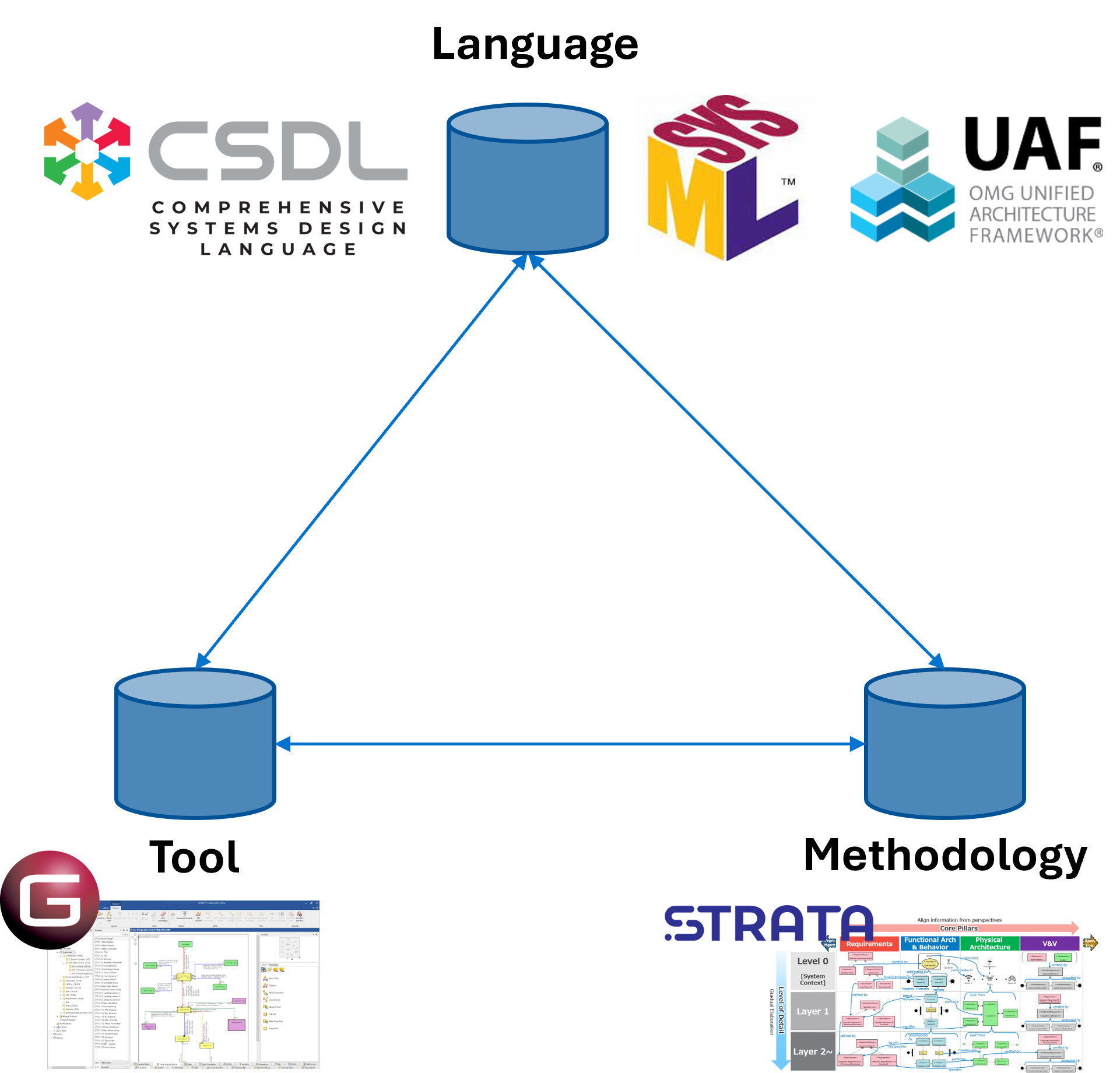
Lenny Delligatti, in his book, "SysML Distilled" (2014), lays out three pillars of MBSE that must be successfully implemented to enable value-added model-based systems engineering & architecture outcomes. These are:
-
Language: a (semi)-formal language that defines the kinds of elements you’re allowed to put into a model, the allowed relationships between them, and the set of notations you can use to display the elements and relationships on diagrams. The language defines the grammar: a set of rules that determines whether a given model is well formed.
-
Methodology: A documented set of design tasks and organizational structure that ensures that everyone on the team is building the system model consistently and working towards a common end point.
-
Tool: A software package that incorporates one or more modeling languages into a structured, relational database of entities and relationships and supports the generation of diagrams and other visualizations of the data to the user. It is not simply a drawing tool – the entities and relationships on a diagram are part of an underlying model. The tools may also support simulations, provide consistency and integrity checking, and provide various ways of ingesting and egesting data.
Vitech Solutions
Vitech offers the following comprehensive solutions for each pillar:
-
Language: CSDL
-
Other supported tools are SysML v1.6, UAF, and DoDAF. See Additional Supported Languages for more information.
-
-
Tool: GENESYS
-
Methodology: STRATA
These MBSE pillar solutions are integrated with one another within the GENESYS tool suite. CSDL forms a critical foundation for GENESYS. The language concepts, parsed into the SE pillars defined in STRATA and combined with completeness and integrity checkers, provides a holistic capability for developing comprehensive system architectures.
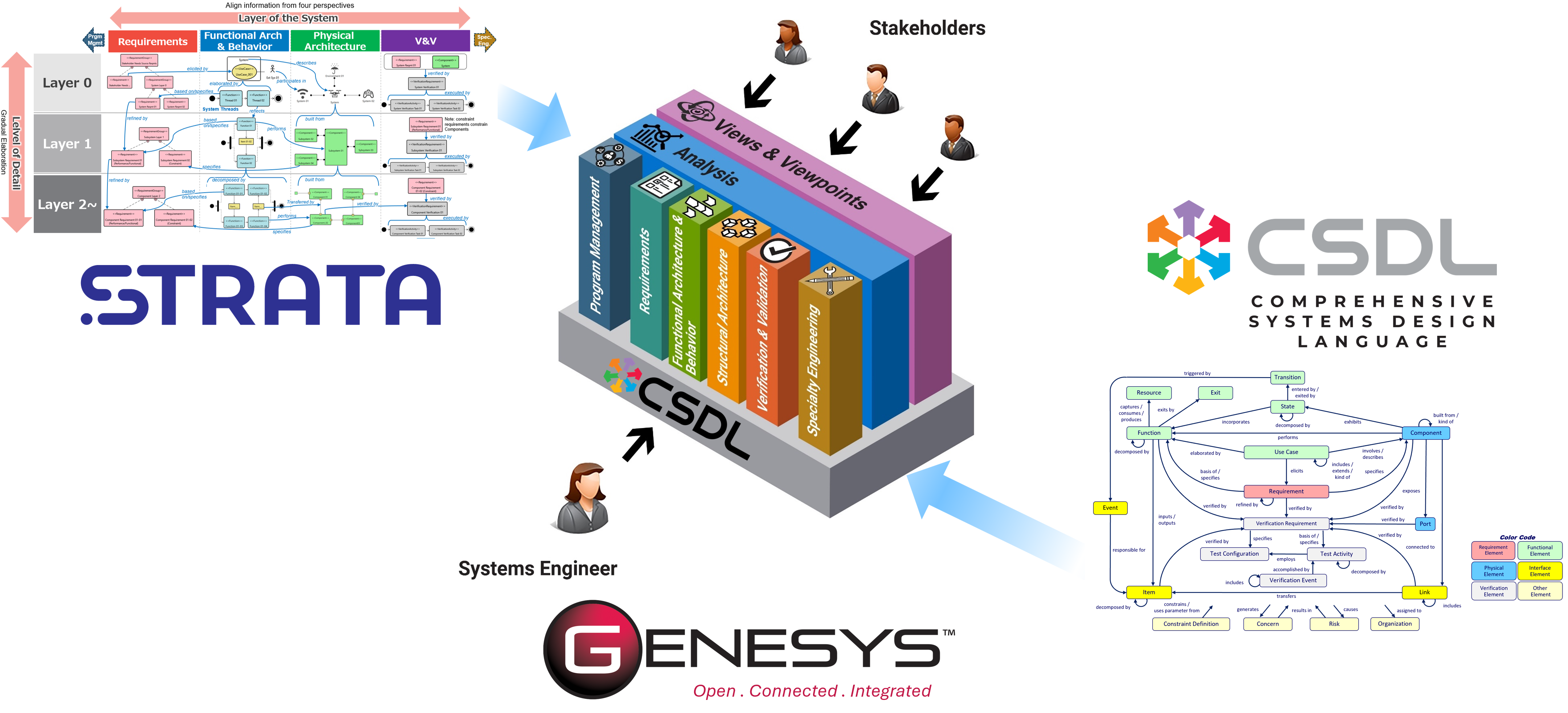
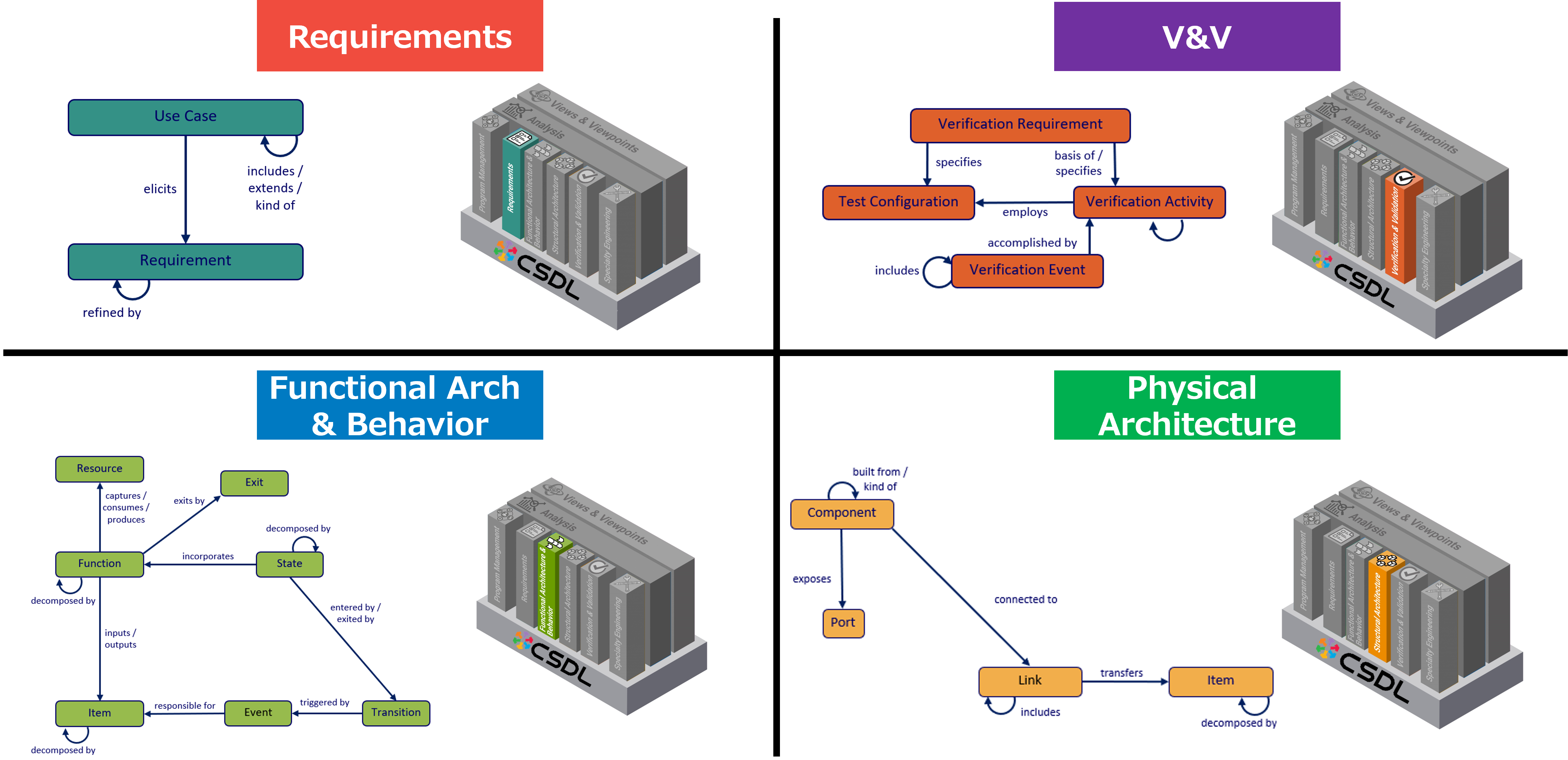
Key CSDL entities and relationships are mapped to a primary STRATA pillar.