

The Set Permissions command, accessed on the Data ribbon or the right-click context menu, enables you to edit the access permissions for the selected entity(s).
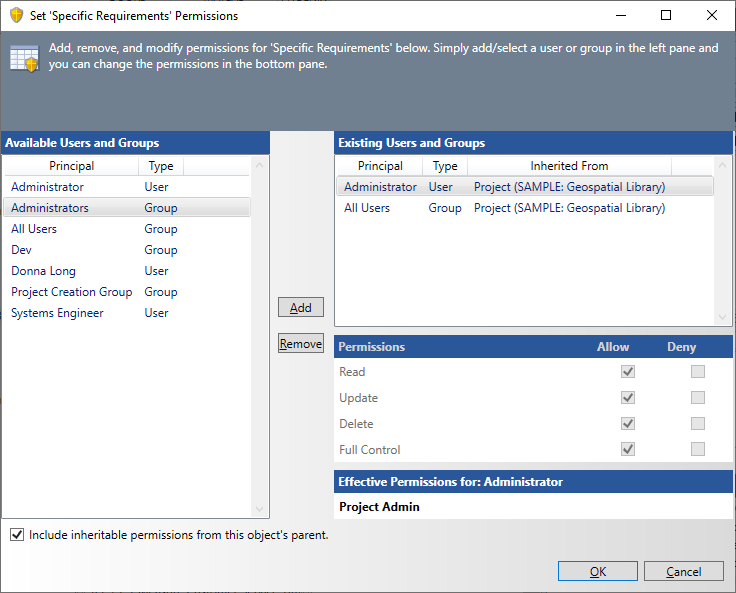
The permissions available are:
-
Read - the user or group has permission to read the entity, its attributes, relationships, and structure. If desired, the user can be denied read permission for specific attributes. In addition, although the user can see the list of all targets, if the user does not have read permission for the target entity, a placeholder will be displayed in place of the target name.
-
Update - the user or group has permission to change the entity, its attributes, relationships, and structure. If desired, the user can be granted or denied update permission for specific attributes.
-
Delete - the user or group may delete the entity from the database.
-
Full Control - the user or group may grant and restrict access to the entity and access to attributes.
All users and groups with permission to the entity will be shown in the Available Users and Groups list. To manipulate the permissions and denials for a user or group, select the user/group in the Available Users and Groups list pane and check/uncheck the desired items. Users and groups not currently explicitly granted permission to the entity are shown in the list on the left. To grant permission to a new user or group, use the right arrow to transfer the user onto the permission list.
If a check box is in the indeterminate state, the selected entities have different states for the specified user or group some entities have granted the permission and some have not.
If you want to reset the permissions, unselect the check box next to Include inheritable permissions from this object's parent and then re-select it.
|
NOTE:
|
What permissions are required to edit entity permissions? To edit permissions for an entity, you must have full control permission for the entity. |
|
NOTE: |
Following standard best practices regarding assigning permissions, it is far better to grant permissions to groups than to individual users. Over time, this approach proves far more manageable and scalable. As new team members are added to the project, they can simply be added to the appropriate group. As team members leave the project, they can be removed from the group. This is far simpler than changing permissions for individual users across the scope of a project. |